
A Tale at the Boundary of Science, Chaos, and Humanity - The Three-Body Problem

A Story Beginning in the Shadow of Science and Revolution
The year is 1967. The place is Beijing, the capital of China.
Young scientist Ye Wenjie witnesses the execution of her father by paramilitary forces. This moment is not only a personal tragedy, but also a symbol of the crushing conflict between science, ideology, and humanity.
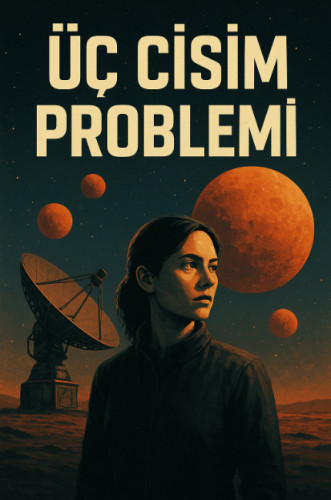
Branded as “the daughter of a traitor,” Ye is sent to a remote military base in Inner Mongolia to avoid exile. This base houses a massive antenna system designed to send signals into outer space — and the direction of Ye’s anger is now clear.
She channels all her hatred toward science and the universe itself. She never imagines that the signals she sends will one day be answered. But the chilling reply that arrives from the depths of space will irreversibly change the fate of humanity:
“Do not answer.”
Traces of the Chinese Cultural Revolution
The roots of the story extend back to the era of the Chinese Cultural Revolution under Mao Zedong.
During this period, science, art, and free thought were branded as “corrupt Western legacies.” Scientists were humiliated, exiled, and even executed.
Liu Cixin’s critique of this era is deeply felt throughout the novel. As in the book, the series portrays the suppression of scientific progress, the individual’s isolation within an oppressive system, and humanity’s attempt to transform science into a means of salvation through powerful symbolism.
The character of Ye Wenjie represents both the destructive and creative potential of the human mind. She is a scientist who uses science not to save humanity, but to escape from it.
This paradox forms the philosophical backbone of the series.
The Three-Body Problem: A Real Scientific Chaos
The title The Three-Body Problem is not merely a metaphor; it is a genuine problem in physics.
According to Newtonian mechanics, it is possible to calculate the motion of two celestial bodies under mutual gravitational attraction. But once a third body is introduced, the equations collapse. No formula can predict the system’s future behavior.
This is the birth of chaos theory.
At the heart of the novel and the series lies this very tension: the endless oscillation between order and chaos, predictability and uncertainty, fate and free will.
The extraterrestrial civilization’s planet, Trisolaris, exists within such a system — a world thrown into chaos by the gravitational pull of three suns.
Seeking escape from their own destruction, its inhabitants search the universe for a solution…
And humanity becomes their answer.
First Contact: Hope or Catastrophe?
At the center of the story lies one of science fiction’s oldest themes: First Contact.
But the question here is clear:
Would first contact truly be humanity’s salvation — or its end?
Stephen Hawking once answered this question bluntly:
“Throughout history, encounters between advanced civilizations and less developed ones have ended badly for the latter.”
Building on this idea, Liu Cixin explores a reality where communication and knowledge-sharing themselves can be deadly. A signal, a message, even a single thought may be enough to trigger the collapse of a civilization.
Philosophical Layers: Humanity, Science, and Morality
The Three-Body Problem is not merely a work of science fiction; it is a philosophical manifesto examining humanity’s existential dilemmas.
Throughout the series, characters push ethical boundaries:
Is the purpose of science salvation — or merely the satisfaction of curiosity?
Should a scientist work for humanity, or for science itself?
These questions permeate every scene. On one side lies a complex scientific framework built on quantum physics, multiverse theories, and game theory. On the other stands a metaphorical exploration of humanity’s capacity for self-destruction.
The Netflix Adaptation: Between Science Fiction and Suspense
The Netflix adaptation was developed by Game of Thrones creators David Benioff and D. B. Weiss, together with writer Alexander Woo.
While not entirely faithful to the novels, the adaptation strikes a successful balance in bringing the story to modern audiences.
Some characters are merged, others reinterpreted. The first season references not only The Three-Body Problem but also its sequels, The Dark Forest and Death’s End. This makes the series more cohesive — yet also more complex.
Shifting much of the setting from China to London gives the story a global tone. Though criticized by some as “Hollywoodization,” this choice has helped the series reach a wider audience.
An Epic That Pushes the Limits of Science
The Three-Body Problem is more than a novel or a TV series — it is a thought experiment that forces humanity to reconsider its place in the universe.
For those who seek order within chaos, fear within hope, and ethical dilemmas within science, this story is a journey.
Whether you read the book or watch the series, what you ultimately encounter is not aliens — but humanity itself.
- Üç Cisim Problemi
- Liu Cixin
- Netflix Dizisi
- Bilim Kurgu
- Kaos Teorisi
- İlk Temas
- Trisolaris
- Kültür Devrimi
- Bilim Ve Felsefe
- Hard Science Fiction
- David Benioff
- D. B. Weiss
- Stephen Hawking
- Bilim Kurgu Romanı
- Netflix Bilim Kurgu Dizileri
Show your reaction
- 0
- 0
- 0
- 0
- 0
- 0
- 0
- 0
- 0
- 0
- 0
- 0
- 0
- 0
- 0
- 0


Comments
Add your comment